New: Online Classroom!

User Rating: 0 / 5

Star InactiveStar InactiveStar InactiveStar InactiveStar Inactive

Es gibt eine gute Neuigkeit! Learn German Online with Nicole has a new, online classroom! This means good-bye, Skype, hello interactive whiteboard!New Online Classroom

Don't get me wrong, Skype has been a wonderful tool for teaching and learning German, especially the screen share option. However the online classroom has even more advantages:

  • live audio and video
  • whiteboard shared by student(s) and teacher
  • saved whiteboards - see what we did in each lesson
  • export capabilities - export the whiteboards as a screenshot
  • highlighter, drawing, and mark-up tools
  • screen share
  • pdf/picture share and mark-up (text and drawing tools)
  • secure access
  • and more!

This online classroom is what I've been dreaming about for two years and I'm thrilled that it's finally here.

So far students have really enjoyed the ability to copy in their texts and to be able to edit them. Yes, when you type in a text on the whiteboard, I can edit it. And the same goes for when I write a sample sentence--you can edit it!

Another wonderful benefit of this classroom is the ability to share pdfs and then to mark them; so when you scan me your chapter test, I upload it to the classroom and we go through it together and we can draw circles, add text, and we can draw right on the pdf. And yes, you can email it to yourself (now OR later!) and save it on your computer or print it out.

Here's what it looks like:
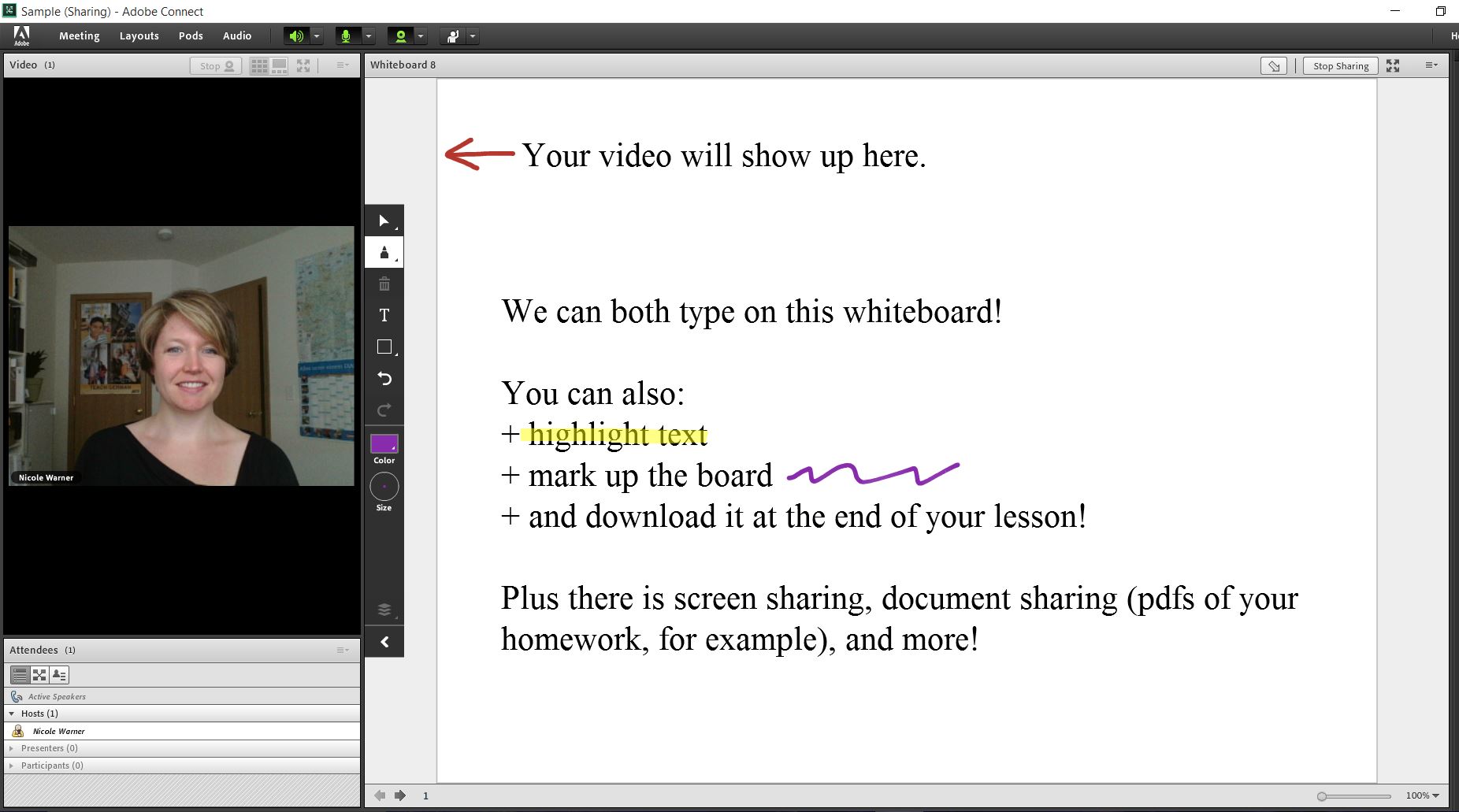
Capture Classroom

Plus, when you sign up for lessons here at LGONicole, you receive access to the exclusive students' area of this site for 24/7 access to extra resources, grammar guides, verb tables, and more. Where else can you find that?!

When you're ready to get going with Deutsch, This email address is being protected from spambots. You need JavaScript enabled to view it.. Ich freue mich auf Sie!


PrintEmail

How I Learned German in 6 Months

User Rating: 3 / 5

Star ActiveStar ActiveStar ActiveStar InactiveStar Inactive

There isn't much of a secret to language learning because it's all about working with the language as much as possible over a length of time. However I can give you tips on how I learned to speak German fluently (and I mean--I could say anything I wanted or needed to say) within about 6 months. Konjunktiv II? Kein Thema. Polite discourse? Absolut! Telling someone off? That, too.

How I Learned German in 6 Months

Don't get me wrong--learning German in 6 months was really tough. I started at an A2 level (the second-lowest level) and busted my way up to C2 (the highest level) and I did it without a whole lot of help outside of class hours. It was really difficult, painful, and even joyful and inspiring. Here's how it happened:

My First German Lessons

First, in the summer of 2002 I took 20 one-on-one lessons with a fantastic teacher at Eloquia, a language school in Frankfurt, Germany. I was in Germany without a whole lot to do during the day and to fill up my time, I took lessons and did homework. This teacher was key--because she prepared me in German grammar construction and corrected me by telling me why something was wrong.

Another benefit of these private lessons was that I didn't accidentally learn other peoples' mistakes! All I had to hear was my voice and my teacher's voice--I was immersed in quality language development.

I then reviewed this material when I returned home and used it to help me write emails to friends in Germany, thus repeating what I already knew. So those 20 lessons actually lasted from the summer of 2002 to the summer of 2003.


Months 1-2

Then in the summer of 2003, when I first moved to Germany, I took two month's worth of lessons at the Goethe-Institut Düsseldorf. I get no money for saying this, and I implore you:  paying the tuition for courses at the Goethe-Institut is worth every penny. I took two intensive courses and the instructor doing the assessments recognized how much I could construct in my mind with only a basic knowledge of German from those 20 private lessons. His name is Herr Fluch and he pulled me into his MIttelstufe course.

There was one problem, though...that summer there was a heat wave in Germany and there was no air conditioning, only a few fans. And I actually panicked when Herr Fluch gave us one particular worksheet...because I had never heard of the N-Deklination before. It was hot, the topics were tough, but the saving grace of the class was, indeed, Herr Fluch.

Continue Reading

PrintEmail

Quick Guide: W-Fragen

User Rating: 4 / 5

Star ActiveStar ActiveStar ActiveStar ActiveStar Inactive

W-Fragen PrintableW-Fragen in German are questions that begin with the question words--in English:  who, what, when, where, why, and how. To contrast, yes/no questions in German begin with the verb ("Arbeiten Sie heute?" "Kommen Sie aus Bayern?").

To help you remember these question words and to help you work out the tough parts, here's a quick guide to the W-Fragen in German:


German   English
was  what
wann  when
wo  where
wie  how
warum  why
wer  who


The Tough Parts Explained:

One tough part is the false friend of wer, because wer means who, not "where." Memorize the rhyming sentence Wer ist er? (Who is he?) to help you remember that wer refers to a he--a person.

The other tough part is the word wann, because wann is the question word, but wenn also means "when." So associate the 'a'  sound of wann with the 'a' sound of Frage, and you'll remember it every time!


Want a Free, Printable Guide?

PDF IconHere's an expanded Quick Guide to the W-Fragen using Vorlagen, model sentences. Print and keep this Quick Guide to help you learn German, learn the Vorlagen, and always know which Fragewort to use! You can also email this article to your fellow German classmates or your German teacher.

*

How do you remember the question words? Do you have more tips? Please comment below!

PrintEmail

Ferien.

User Rating: 0 / 5

Star InactiveStar InactiveStar InactiveStar InactiveStar Inactive

Ferien.

Vacation. Holidays.


School holidays. School vacation.


Ferien is always plural! Ferien is pronounced "FAIR-ee-en."


Nicole macht diese Woche Ferien.


Bis nächste Woche!


~Nicole

PrintEmail

Aufräumen ist nicht putzen!

User Rating: 0 / 5

Star InactiveStar InactiveStar InactiveStar InactiveStar Inactive

Aufraeumen ist nicht putzenMany German learners want to know what "to clean" is. The verb "to clean" in German is putzen. However putzen is something very specific in German--it may not be what you think!

For Germans, putzen is the actual process of cleaning, and nothing else. Americans think of cleaning as vacuuming, putting away books that might be laying about, doing the laundry, and any other amount of things. However putzen does not indicate that things are being picked up. This is something different entirely.

Most Germans keep things picked up all the time, they are German after all. (Although I have seen some notable exceptions to this!) To pick up around the house or to clean off the table is aufräumen.

Because Germans are very specific about verbs and their uses, it's important to keep this in mind when you use the verbs aufräumen and putzen. Here is a short list for each of these verbs to help you know when to apply it:

aufräumen:

  • picking up clothes
  • clearing off a table
  • organizing papers on a desk
  • organizing your desk


putzen:

  • vacuuming and washing the floors
  • cleaning the bathroom
  • washing windows
  • polishing shoes (!)
  • washing fruit


Have you ever discussed this difference with a German speaker? I bet s/he was specific about it! What did s/he say? Comment below!

PrintEmail

Die Johannes-Passion von J. S. Bach

User Rating: 0 / 5

Star InactiveStar InactiveStar InactiveStar InactiveStar Inactive

One of the pinnacles of German classical music culture is the Johannes-Passion from Johann Sebastian Bach. And since it is Lent, that means it is time for the Passion of Christ.

For those of you who don't know, I'm a professionally trained, classical musician, and I mix music and German teaching as my career. It's a wonderful combination of the foreign language of German and the language of Music, and when I get to sing in German, well, I get a little bit verklemmt. During my 5 years in Germany I spent several years singing with the Gächinger-Kantorei, the professional choral ensemble of the Internationale Bachakademie Stuttgart (IBA). (By the way, the IBA is mentined in Passwort 3 for those of you in that book!) We sang a lot of music, and a lot of it in German.

Thus this week's blog post is short and sweet because I have lots of Proben (rehearsals). If you're close or able to travel, we're in St. Paul, MN on Saturday and in Winona, MN on Sunday. Ich hoffe, wir sehen uns dort!


The St. John Passion from J. S. Bach

PrintEmail

Methods for Homeschool German: Part 3

User Rating: 0 / 5

Star InactiveStar InactiveStar InactiveStar InactiveStar Inactive

Herzlich willkommen zurück! Here is the third in a series of methods to help you add German to your homeschool routine.


Methods for Homeschool German Part 3

This week's Homeschool German method involves travel and I've presented a couple of different ways to incorporate Germanic locations into your family vacation--at different budgetary sizes. Of course, it all begins with something the Germans in particular excell at--Geld sparen! (Saving money!) But wait until you get to the end, for something truly and uniquely German!


1. Sparen Sie Geld!


For small children, a Sparschweinchen (piggy bank) will be a great way to help your children begin the journey of saving for a vacation. For older kids, saving up for their vacation expenditures in an envelope or their bank account is a great way to combine this German habit with trip preparation.


2a. Take your family vacation...to a German settlement area like Milwaukee, WI or Fredericksburg, TX


There are so many wonderful cities and regions with German heritage in the US--there is probably one within driving distance for you! Why not make it a road trip and pack your own Brötchen for the trip? Have picnics with a thermos of coffee instead of stopping for fast food--that is some serious, old school German road tripping.

Continue Reading

PrintEmail